Best AI video ad generators in 2026: an honest shortlist
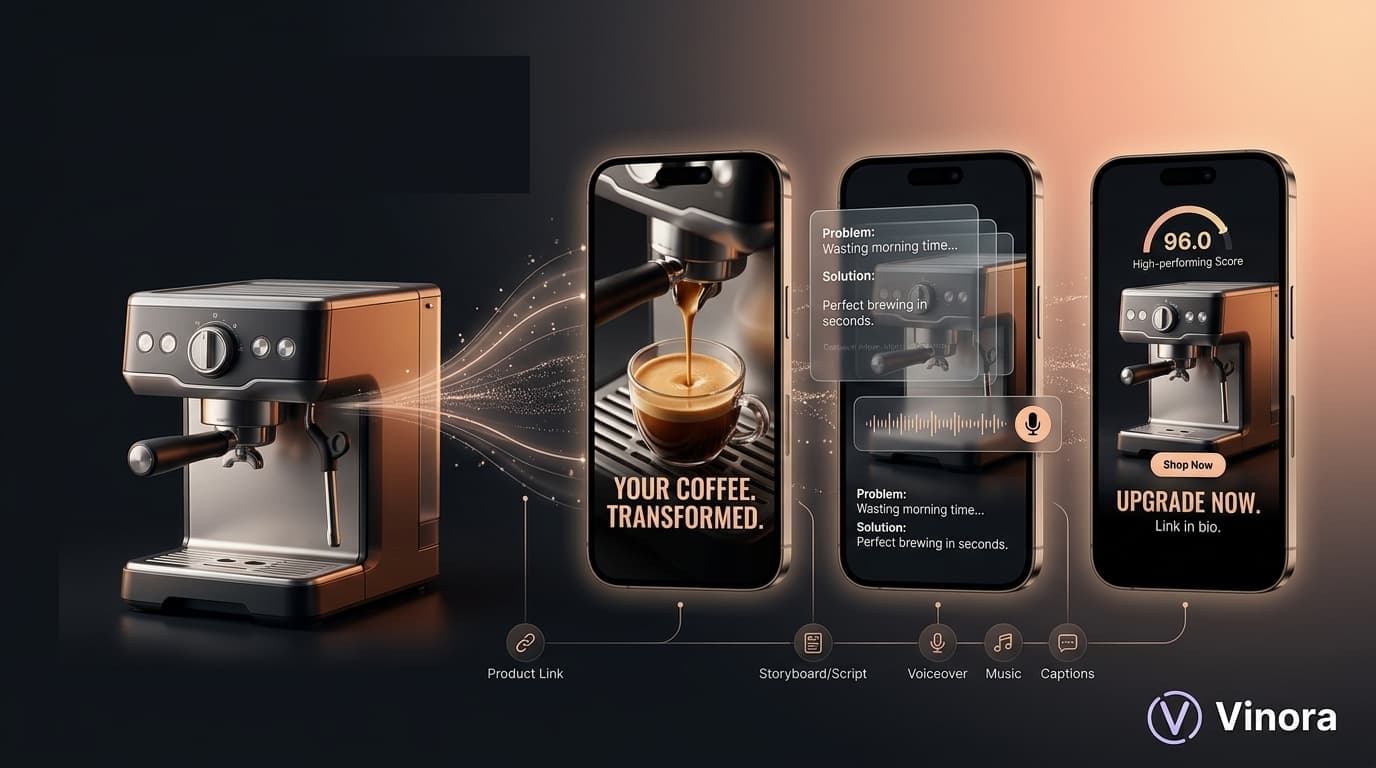
The best AI video ad generators in 2026 aren't the ones with the flashiest text-to-video demo. They're the ones that take a product image or a store URL and hand back a finished 9:16 ad — hook, script, footage, voice, music, captions — without you stitching six tabs together. That's the bar, and most tools on the market still don't clear it.
This is an honest shortlist. No affiliate fluff, no vendor name-dropping for SEO weight. If a tool is on here, it's because it does one specific job well for founders, marketers, and creators shipping short-form ads this quarter.
What counts as an "AI video ad generator" in 2026?
The category has split into three layers, and conflating them is why most comparison posts feel useless:
- Text-to-video models — raw clip generators. You give them a prompt, you get a 5–10 second clip. No script logic, no ad structure, no captions.
- Single-layer ad tools — voiceover-only, captions-only, or avatar-only platforms. Useful, but you're still the editor.
- End-to-end ad generators — input is a product (link or image), output is a finished short-form ad. This is the layer that actually saves time.
A real AI video ad generator handles the full chain: concept → script → video → voice → music → captions. If a tool only does one of those, call it what it is — a clip generator or a captioner — not an ad generator.
How does an end-to-end AI ad generator actually work?
The pipeline is more linear than the marketing pages suggest. Most production-grade systems run roughly this sequence:
| Stage | What happens | Why it matters |
|---|---|---|
| Ingest | Tool reads your product link or image and extracts category, value prop, and visual cues | Determines whether the script is on-brief |
| Concept | A short ad concept is generated (hook + promise + proof + CTA) | The concept decides if anyone watches past second two |
| Script | Concept is expanded into shot-by-shot copy with timing | Bad pacing kills retention more than bad visuals |
| Video | Each shot is generated or composed from your product image | This is where most tools visibly fail — wrong product, wrong angle |
| Voice | TTS voice that matches the script's tone | Generic voices feel like spam ads |
| Music | Bed music sized to the script length | Mood mismatch breaks the hook |
| Captions | Burned-in captions, kinetic or static | About 85% of feed views are sound-off |
If any stage is missing, you're not buying an ad generator — you're buying a half-pipe and finishing the ad yourself in CapCut.
When should you use an end-to-end tool vs a single-layer tool?
The split is usually cleaner than people expect:
- End-to-end — you ship multiple ads per week, you don't have an editor on staff, and your creative is bottlenecked on volume, not on a hero film.
- Single-layer (clip generator) — you have a strong creative team and just need a 6-second B-roll clip you can't shoot.
- Single-layer (captioner / voiceover) — you already have footage and one piece is missing.
- Manual edit in CapCut / Premiere — you're shooting a hero brand film. AI generators are not the right tool for a 60-second narrative spot.
If you're a founder or solo marketer running paid social, you almost certainly want the end-to-end layer. The math of single-layer tools rarely works once you account for the time spent gluing them together.
The honest shortlist for 2026
Four categories worth knowing, with what each is genuinely best at.
1. End-to-end product ad generators
This is the layer Vinora lives in. You paste a product link or upload an image, pick a style, and Vinora returns a finished 9:16 ad — concept, script, video, voice, music, and captions — in one chat. The pitch isn't "AI video," it's publish-ready ads without leaving one tab. For ecommerce founders shipping 5–20 ad variants a week, this is the only category that compresses the workflow enough to matter.
What to look for in this category:
- Accepts a store URL or product image, not just a text prompt.
- Outputs a complete ad, not a clip you finish elsewhere.
- Renders 9:16, 1:1, and 16:9 so the same ad ships to Reels, TikTok, and YouTube Shorts.
- Lets you iterate by chat ("make the hook punchier," "swap the music") instead of regenerating from scratch.
2. Raw text-to-video clip generators
Useful when you need a single surreal or impossible-to-shoot shot. Not useful as a standalone ad solution — you still need to write the script, record the voice, lay the music, and burn captions yourself. Treat these as stock footage replacements, not ad tools.
3. Avatar / talking-head tools
Good for B2B explainer ads, training content, or markets where a presenter format converts. Bad for product-led DTC ads in 2026 — feeds have gotten very good at filtering out avatar-narrated creative.
4. Single-layer finishing tools (captions, voiceover, music)
Worth a slot in your stack if you're editing manually. Skip them if you're already on an end-to-end platform — the integrated version is almost always faster than the best-in-class standalone.
What separates a good AI ad from a generated-looking ad?
Three checkpoints, in order of how often they kill the creative:
- The first 1.7 seconds. If the hook doesn't signal the product category and set up the promise, retention collapses before the script even starts. AI tools that auto-generate hooks from a generic template lose here every time.
- Product fidelity in the visuals. A generated video where the product subtly morphs between shots reads as fake within two viewings. Tools that anchor every shot to your uploaded product image hold up. Tools that re-imagine the product each shot don't.
- Caption pacing. Captions that lead the audio by ~80ms feel native to TikTok and Reels. Captions that lag, or land all at once, feel like ad-software output. This is a small thing that separates scroll-stopping from scroll-past.
For platform-specific specs, check the official creator docs — TikTok Creator Center, Meta Business Help Center, and YouTube Shorts guidelines — rather than third-party blog summaries that go stale within a quarter.
How to pick one this week
A short decision sequence that works for most teams:
- Write down how many ad variants you actually need to ship in the next 30 days. If it's under 5, a manual workflow is probably fine.
- If it's 5+, restrict the search to end-to-end generators. Single-layer tools won't get you there.
- Run the same product through two or three tools. Judge the first 1.7 seconds of each output, not the full ad.
- Pick the one whose hook you'd actually run as paid media. That's the only test that correlates with results.
Most teams over-evaluate on visual polish and under-evaluate on hook quality. Reverse that, and the shortlist gets very short, very fast.
How does Vinora fit?
Vinora is the end-to-end option in this list. You give it a product link or image, pick a style, and it returns a publish-ready short-form ad — concept, script, video, voice, music, and captions — in one chat. It's built for founders and marketers who need to ship ads weekly, not for filmmakers crafting a single hero spot. If you want to see the pricing before you try it, or read the related breakdown of what makes a hook stop the scroll, both are linked.
The takeaway
The best AI video ad generator for you in 2026 is the one that ends with an ad you'd actually publish — not a clip you'd edit. Pick by the layer of the problem you actually have. If you're shipping ads weekly, you want end-to-end. If you're polishing one hero film, you don't want any of this. Run one product through your shortlist tomorrow, judge the first 1.7 seconds, and decide from there.
Frequently asked questions
What is the best AI video ad generator in 2026?+
The best AI video ad generator in 2026 is an end-to-end tool that turns a product link or image into a finished 9:16 ad — concept, script, video, voice, music, and captions — without manual stitching. Vinora is built specifically for this workflow. Single-layer tools (text-to-video, captions-only, voiceover-only) are useful as add-ons but don't replace an end-to-end generator.
Are AI-generated video ads good enough for paid social in 2026?+
Yes, AI-generated ads now perform on par with manually edited ads on TikTok, Reels, and Shorts when the hook and product fidelity are strong. The failure mode is almost always a weak first 1.7 seconds or a product that morphs between shots, not the AI generation itself. Judge tools by hook quality, not visual polish.
How long should an AI-generated product ad be?+
Most AI-generated product ads should run 9–15 seconds for paid social in 2026. Hooks longer than three seconds usually leak half the viewers, and stories longer than 15 seconds rarely outperform a tighter cut. Reserve 30–60 second runtimes for retargeting or YouTube pre-roll.
Can I make TikTok ads with AI without an editor?+
Yes — end-to-end AI ad generators are designed for exactly this case. You upload a product image or paste a store link, pick a style, and the tool returns a publish-ready 9:16 ad with burned-in captions. No editor or timeline software is required if the tool covers concept through captions in one pass.
What's the difference between a text-to-video model and an AI ad generator?+
A text-to-video model generates a single 5–10 second clip from a prompt. An AI ad generator runs the full pipeline — concept, script, multi-shot video, voice, music, and captions — and returns a finished ad. Text-to-video is a component; an ad generator is the product.
Written by
Vishal Agrahari
Keep reading
Meta Advantage+ vs. manual creative testing: an AI workflow comparison
How Advantage+ automation and manual creative testing fit together when AI generates hooks at catalog speed.
How much should a video ad cost in 2026? (and when AI is cheaper)
Compare UGC, agency, and AI video ad production costs—and when AI lowers cost per testable hook, not just cost per minute.
What makes a scroll-stopping ad in 2026 (hooks, pacing, voice)
A 2026 framework for scroll-stopping short ads—first-frame hooks, second-by-second pacing, and voice choices for sound-off feeds.