What is a video ad hook? Definition, examples, and formats

A video ad hook is the first 1–3 seconds of a short-form ad — the part that decides whether a viewer watches the rest or flicks past. On TikTok, Reels, and Shorts, the hook isn't a stylistic choice. It's the entire game. Most ads don't fail because the offer is bad; they fail because the first second never earned the second one.
If you're running paid social or organic short-form, the hook is the highest-leverage line you'll write all week. Get it right and the same product, same script, and same CTA can do 3–5x the watch-through. Get it wrong and even a great product looks like noise.
What is a video ad hook, exactly?
A video ad hook is the opening visual + line of a short-form video ad — typically the first 1 to 3 seconds — engineered to stop a scrolling viewer and signal that the next ten seconds are worth their time. It's part copy, part shot, part sound. A hook is not the ad's headline, the offer, or the CTA. It's the doorway.
A useful working definition: the hook is everything that happens before the viewer has decided to keep watching. Once they've decided, you're in the body. Until then, every frame is the hook.
Why is the hook so important in 2026?
Average attention on a vertical feed is roughly 1.7 seconds before a viewer decides to swipe. That's not a stat about Gen Z — it's a stat about thumbs. The platforms (TikTok, Instagram Reels, YouTube Shorts) reward retention curves, so a weak first second drops you out of distribution before your CTA ever loads.
Three things follow from that:
- The hook decides reach, not just clicks. Algorithms watch the 3-second retention rate.
- A great offer with a bad hook gets buried. A mediocre offer with a great hook gets tested.
- Hooks are testable independently of the rest of the ad — change only the first 2 seconds and you'll see the entire funnel move.
TikTok's own creator guidance and Meta's short-form best practices both put the same instruction first: front-load the value.
How does a video ad hook actually work?
A working hook does three jobs in under three seconds — in this order:
| Checkpoint | Time | What it has to do |
|---|---|---|
| Stop the scroll | 0.0–0.5s | A pattern-break: motion, face, color, or a sound the feed isn't currently making. |
| Signal the category | 0.5–1.5s | Tell the viewer what this is about so the right audience self-selects. |
| Set up the promise | 1.5–3.0s | Imply the payoff — the result, the surprise, or the answer that comes next. |
If a hook does only the first job, you get views but no conversions (the wrong people watched). If it skips the first job, the right people never see it. All three or none.
What are the main video ad hook formats?
There are five formats that consistently outperform on short-form. Most viral ads are one of these, sometimes two stacked.
- The sharp-claim hook. A confident, specific statement. "This is the only $30 ceramic pan that doesn't peel after a year."
- The question hook. A question the viewer already has. "Why does my skin look worse after I moisturize?"
- The pattern-break hook. A visual or sound that doesn't fit the feed — a hand cracking the product, an unexpected POV, a sudden silence.
- The result-first hook. Show the after, then explain. "This is day 14." Cut to the before.
- The contrarian hook. Argue against the obvious. "Stop using a ring light. Here's what to use instead."
When should you use a hook vs a result-first opener?
Both stop the scroll. They're not interchangeable.
- Use a claim or question hook when the product needs context — skincare, software, anything where the viewer has to understand the problem before the result means anything.
- Use a result-first hook when the transformation is visual and self-evident — cleaning products, makeup, fitness, before/after physical objects.
- Use a pattern-break hook when the category is saturated and every competitor opens the same way. If everyone else starts with a face talking, start with hands. If everyone starts loud, start silent.
- Use a contrarian hook when you have a genuinely non-obvious take. Don't fake it — viewers feel forced contrarianism instantly.
A practical test: write three hooks for the same ad in three different formats. Run them as three separate creatives. The winner is almost never the one you would have picked.
How do you actually write a video ad hook?
Five rules that survive contact with real campaigns:
- Cut the throat-clearing. No "Hey guys", no "So today I want to talk about". The first word should be load-bearing.
- Be specific in the first line. "A faster checkout" loses to "checkout in 4 taps".
- Match the visual to the line. If the line says "this is what happens when you wash hair with hard water", the frame must show hard water hair, not a face.
- Read it without sound. Around 70–80% of feed views start muted. If the hook only works with audio, it's broken.
- Write ten, ship three. Hooks are cheap to draft and expensive to test. Front-load the volume on the writing side.
A useful template: <surprising specific> + <who it's for> + <what comes next>. Example: "This is the 19-second skincare routine my dermatologist actually does — and the three steps everyone skips."
How does Vinora fit?
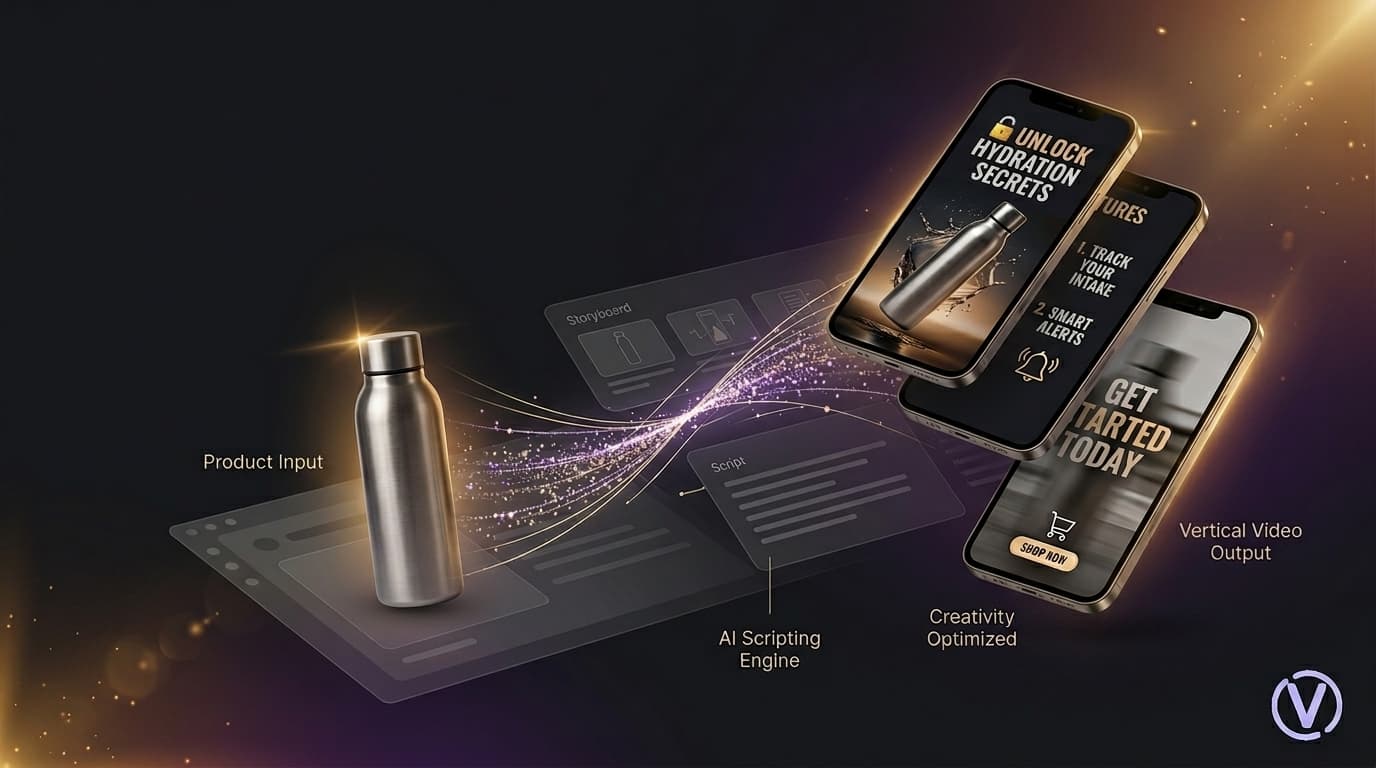
Vinora generates short-form product ads end-to-end from an image or a store link — concept, script, video, voiceover, music, and captions in one chat. The relevant part for hooks: Vinora drafts multiple hook variants per ad by default, in different formats (claim, question, pattern-break), so you can ship three creatives instead of betting on one. You can see how the workflow runs on the home page or check pricing for plan limits. For more on writing the rest of the script, see our guide to short-form ad scripts.
The one thing to take away
The hook isn't the intro to your ad. It is the ad, until the viewer has decided to stay. Treat the first three seconds as a separate piece of work — write it last, write ten of them, and test the top three. Everything downstream is leverage on that single decision.
Frequently asked questions
How long should a video ad hook be?+
A video ad hook should be 1 to 3 seconds long — short enough to land before a viewer's thumb decides to scroll. On TikTok, Reels, and Shorts, the 3-second retention rate is the metric the algorithm rewards, so anything past three seconds isn't really a hook anymore.
What makes a good video ad hook?+
A good video ad hook does three things in under three seconds: stops the scroll with a pattern-break, signals the category so the right viewer self-selects, and sets up a promise that makes the next ten seconds feel worth it. If it only stops the scroll, you get views but no conversions.
What's the difference between a hook and a CTA?+
A hook is the opening 1–3 seconds that earns attention; a CTA is the closing line that converts it. The hook decides whether the ad gets watched at all, while the CTA decides what the viewer does after watching. A weak hook makes even a perfect CTA invisible.
Are hooks the same on TikTok, Reels, and Shorts?+
The principles are the same across TikTok, Reels, and YouTube Shorts — stop the scroll, signal category, set up the promise — but the texture differs. TikTok rewards rawer, talking-to-camera hooks; Reels rewards polished visual pattern-breaks; Shorts rewards hooks that read clearly without sound.
Can AI write video ad hooks that actually work?+
AI can draft strong hook variants quickly, especially when it's grounded in your product and audience instead of generic prompts. The win isn't replacing a copywriter — it's generating ten viable hooks in the time it takes to write one, so you can test three on the platform and let the data pick the winner.
Written by
Vishal Agrahari
Keep reading

How long should a TikTok product ad be in 2026?
The honest answer to TikTok product ad length: 9–15 seconds for cold traffic, 21–34 for warm. Here's how to pick — and where to spend each second.
Video ad sizes 2026: TikTok, Reels, and Shorts
One vertical master, three crops. The current aspect ratios, dimensions, and length caps for TikTok, Reels, and Shorts ads — and when to fall back to 1:1 or 16:9.
Creatify pricing review: tiers, fit, and tradeoffs
An honest read on Creatify's pricing structure for DTC brands — how the tiers gate features, who they fit, and where they stop fitting as you scale variants.